Since 1976
Cretan Honey
Food of the Gods, from the mountains of Crete.
Honey is food for the Gods and for mortals. For thousands of years it has been a special treat for everyone. Excavations at Phaistos in southern Crete brought to light clay pots with traces of honey, showing that honey was an essential part of the diet of the ancient Cretans — and it remains a vital part of the Mediterranean diet today.
The Gods of Olympus were nourished with nectar and ambrosia.
According to Hesiod and Pindar, Aristaeus, son of Apollo and Cyrene, introduced the keeping of bees, the vine and the olive. He became immortal because Earth and the Hours, who raised him, fed him with ambrosia.
The bee and the hive
The honey bee domesticated by humans belongs to the genus Apis (species Apis mellifera). In the past, bees were kept in baskets, wooden boxes, clay pots or hollow tree trunks. The hive with movable frames and the artificial comb brought big changes: less waste of honey, wax and work for the swarm, easier care of the colony and better control of disease.
Location is vital for successful beekeeping: the ideal area has abundant blossom in spring, summer and autumn, so the colony can grow, gather a rich harvest of quality honey and store enough food for winter. Modern beekeepers move their hives to follow the flowering seasons.
The flora of Crete
Crete is rich in wild plants such as thyme, sage, oregano, pine, acacia, strawberry tree and eucalyptus, as well as cultivated citrus. Thyme honey is a category of its own thanks to its intense aroma and flavour: even a small share (5%) changes the scent of other honeys. Cretan pine honey comes mainly from Sfakia and the Selakano area of Lasithi.
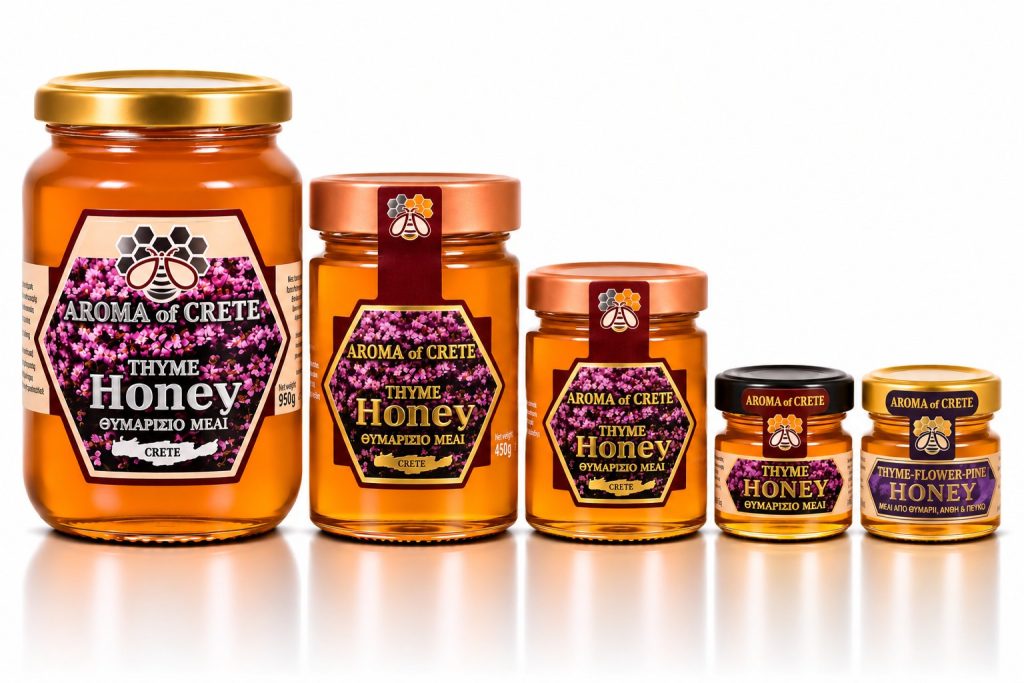
The Nikolakakis family’s production focuses on thyme honey, without blending or any alteration of its quality — because what matters most is keeping honey as pure as nature made it.
Gifts of the hive
- Honey: according to the F.A.O., the sweet food produced by bees from plant nectar, which they carry to the hive, enrich, ripen and seal in the comb.
- Wax: collected at harvest time and reused in beekeeping, candles, cosmetics, art and industry.
- Pollen: a large hive gathers 25–30 kg of pollen every year.
- Royal jelly: a creamy substance secreted by worker bees; it is the exclusive food of the queen, hence its name, and is rich in proteins.
- Propolis: a resin the bees collect from tree buds.
Bees and pollination
The greatest contribution of bees is pollination. An average colony is estimated to be worth 20 to 40 times more for the pollination it provides than for the honey it produces. Wildfires and large monocultures have reduced wild pollinators, making the honey bee even more precious to nature.
Honey contains more than 180 different substances, including simple sugars and minerals such as phosphorus, magnesium, calcium, iron and potassium.